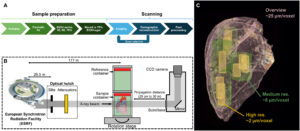
Abstract: Imagine being able to zoom into a human organ from the scale of the entire heart down to a single cell, all in 3D, and without ever picking up a scalpel. This is the reality behind the Human Organ Atlas (HOA), a groundbreaking open-access library of human anatomy. Using a high-powered X-ray technique called HiP-CT, researchers are capturing the intricate details of organs like the brain, lungs, and kidneys in unprecedented clarity. This “Google Earth” for the human body allows scientists and doctors to explore spatial relationships and structures that were previously invisible, providing a new map for understanding both healthy life and complex diseases.
The best part? This incredible resource isn’t locked away in a private lab. It is built on the principle of open science, meaning researchers, students, and educators worldwide can access these massive datasets at no cost. Whether it’s studying the impact of COVID-19 on lung tissue or training the next generation of AI to identify early signs of cancer, the Human Organ Atlas is bridging the gap between traditional anatomy and the future of digital medicine. By making this data “FAIR” (Findable, Accessible, Interoperable, and Reusable), the project ensures that anyone with a curious mind can contribute to the next big medical breakthrough.
Read the full article here: Seeing Inside the Human Body Like Never Before