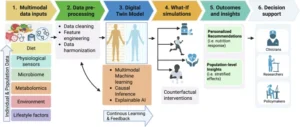
Abstract: Dietary factors represent a critical, highly modifiable lever for global health, yet traditional “one-size-fits-all” food guidelines consistently fail to account for how differently individual bodies react to the same meals. To solve this problem, the medical community is moving toward Precision Nutrition (PN) by leveraging massive, multi-omic repositories like the UK Biobank and the All of Us Research Program. By feeding advanced artificial intelligence (AI) and tree-based machine learning models a deep mix of genetic profiles, clinical biomarkers, and lifestyle data extracted from these biobanks, researchers can finally map out unique metabolic patterns. In fact, large cohort studies show that when gradient-boosted trees integrate a participant’s specific gut microbiome sequence with their clinical history, the algorithms can accurately forecast postprandial glycemic spikes, proving that our ideal diets are completely personal.
However, building these customized nutrition models is incredibly challenging because biobank datasets feature diverse data layers that are episodic, context-dependent, and highly prone to self-reporting errors. Merging high-frequency wearable time series, like continuous glucose monitors, with snapshot food questionnaires introduces major statistical noise and incompatible measurement standards that can easily cause standard AI algorithms to overfit the data. To overcome these complex hurdles, data scientists are introducing strict cross-layer harmonization standards, unified phylogenetic references, and specialized tools like Graph Neural Networks to map structural interactions between microbes and metabolites. By moving past generic algorithms and implementing these nutrition-specific best practices, the scientific community is building an auditable, data-driven pipeline capable of turning raw biobank specimens into safe, actionable dietary interventions.
Sounds Interesting? Read the full article here: https://www.nature.com/articles/s41467-026-75004-w#Abs1